|
'The Plastic Country - Australia's Hidden Plastic Crisis', "an urgent documentary exposing Australia’s hidden relationship with plastic and the growing consequences for our health, wildlife and environment", is now available on YouTube. It features powerful, thought provoking and beautifully filmed conversations and case scenarios presented through the eyes of an engaging and committed 25 year old. Please watch and share.
0 Comments
We would like to invite you to attend our BSFG General Meeting at 7.30pm on Thursday 26th August at the Benalla Uniting Church.
In keeping with "Plastic Free July" (previously postponed due to covid restrictions), we will be screening the documentary "Plastic Wars". Issues such as clear labelling on packaging for recycling, are raised in this documentary. There will be time for discussion after the film. A light supper will be served at the conclusion of the evening. Current covid protocols will be followed. For indoor public gatherings, masks and social distance are needed. Masks can be removed during supper, when we ask people to maintain social distance. Please RSVP your attendance for Covid numbers to [email protected] Please visit News on our BSFG website for more about Plastic Free July. https://www.bsfg.org.au/news Judy Schwarzman Secretary BSFG To add to your favourites!
Commencing a regular series of articles from BSFG in the Ensign, the first articles highlighted 'Plastic Free July' -
Media Team Dear BSFG Members and Supporters,
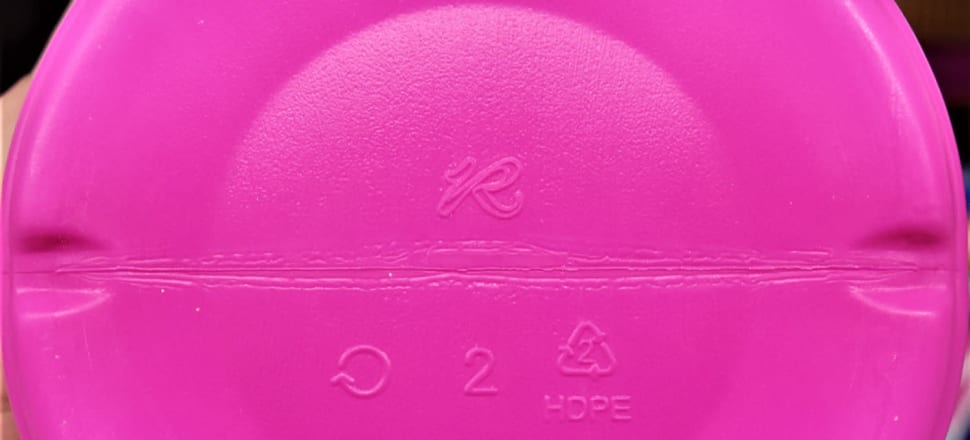
We would like to invite you to attend our BSFG General Meeting at 7.30pm on Thursday 22nd July at the Benalla Uniting Church. In keeping with "Plastic Free July" we will be screening the documentary "Plastic Wars". Issues such as clear labelling on packaging for recycling, are raised in this documentary. There will be time for discussion after the film. A light supper will be served at the conclusion of the evening. Current covid protocols will be followed. For indoor public gatherings, masks and social distance are needed. Masks can be removed during supper, when we ask people to maintain social distance. Please RSVP your attendance for Covid numbers to [email protected] Please visit News on our BSFG website for more about Plastic Free July. https://www.bsfg.org.au/news Judy Schwarzman Secretary BSFG From Simon Ruppert, the Ensign, 7 July, p 2: "This week's column, 'Plastic recycling symbols explained' from Benalla Sustainable Future Group explains the various recycling symbols found on Australian products. "Most people think if a plastic product or container has a triangular symbol with a number inside, it is recyclable, but unfortunately, this is very confusing, and far from the truth. If you take a closer look at the recycling symbol you will see a number in the middle. The numbers simply distinguish between the different types of plastics, and hopefully the following information will help readers correctly deal with any plastic products they need to dispose of: ● Code 1 - Polyethylene Terephthalate: Products such as soft drink bottles and common food packaging can be recycled; ● Code 2 - High Density Polyethylene: This type of material is usually found in packaging for things like detergents, bleach, shampoo, conditioner and milk containers, and can also be recycled; The number inside the triangle recycling symbol explains if, how and where plastic packaging can be recycled. The two indicates this packaging can be placed in a recycling bin ● Code 3 - Polyvinyl Chloride: PVC includes pipes, toys, packing, etc and can be difficult to recycle and a major health threat - it should never be sent to landfill or placed in your recycle bin. Contact Council for advice on how to dispose of it; ● Code 4 - Low Density Polyethylene: LDPE is the material used to create things like garbage bags, sandwich bags, shopping bags, etc. These kinds of soft plastics are collected in special containers at supermarkets, so do not put them in your own recycle bin; ● Code 5 - Polypropylene: Polypropylene materials can be used to create products like clothing, tubs, ropes or bottles and can be turned into fibres when recycled properly, so they may be placed in your recycle bin; ● Code 6 - Polystyrene: Polystyrene is probably the most difficult plastic product to deal with. It must not be placed in your roadside recycling bin, and because it is manufactured from petroleum, it is a very contaminating product in landfill. It is best to avoid buying products packaged in polystyrene; and ● Code 7- All other plastics: Must not be placed in recycling bins - can include anything from acrylic to nylon The number inside the triangle recycling symbol explains if, how and where plastic packaging can be recycled: The one indicates it can be placed in a recycling bin. In summary, don't think that plastic is recyclable simply because it has a number inside a triangle.
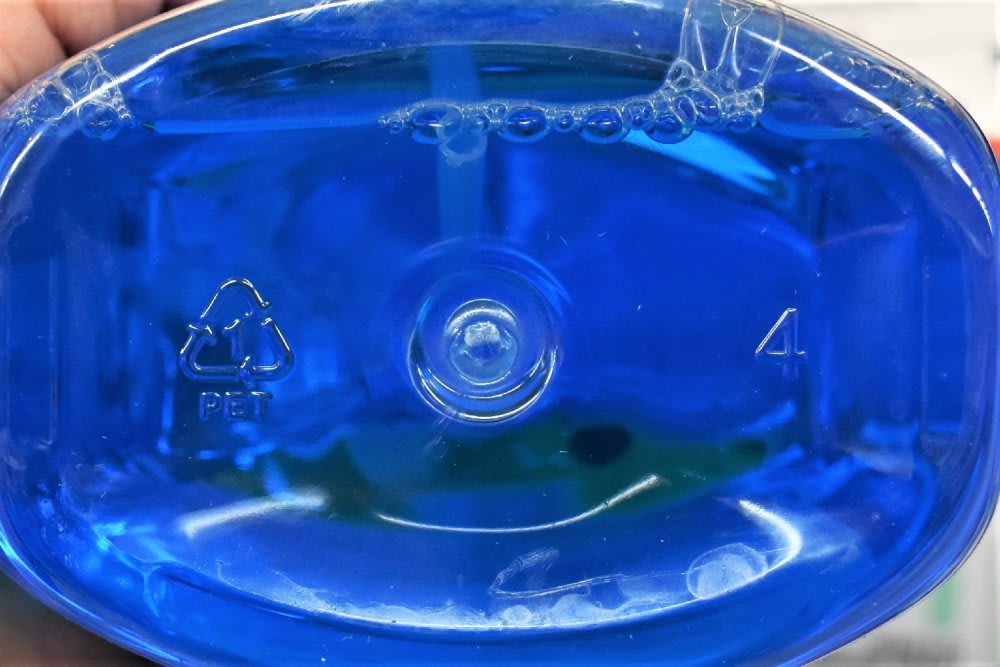
Generally, codes 1,2 and 5 are okay to recycle, and code 4 needs to go to soft plastics bins at supermarkets, for example. For all other plastics, you need to check with council to determine the best method to deal with the problem. To help reduce the plastic recycling conundrum, why not try to avoid buying goods packaged in plastic. During July, think "plastic free", and you might just find it is easier than you thought, and this will go a long way to solving one of our major pollution problems." Plastic Free July is a 2011 initiative developed by Rebecca Prince-Ruiz, and a small team in local government in Western Australia It aims to raise awareness of the amount of plastic in our lives by encouraging people to eliminate the use of single-use plastic. The initiative is a global movement that helps millions of people be a part of the solution to plastic pollution.
The challenge is to refuse single use plastic during July, and once in the habit, continue to do so. Some of you may think it is difficult to stop using plastic, and it is. Plastic is ubiquitous and it is made to last a very long time. It is packaged around our food. There is evidence now to say it has started to become a part of our food. It is in our make-up and personal hygiene products. It is in our clothing. However, if we put in a little thought and effort, we all can reduce our usage of plastic. Benalla Sustainable Future Group hopes that the Benalla community can rise to the challenge, and we offer the following ideas to aid people in this endeavour:
Continue the challenge if travelling:
Think - Reduce, Reuse, Refuse, Rethink, Repair. If we are all a little wiser with our purchases and consumption habits, a cleaner and healthy environment will follow. Think about changing your relationship with plastics and challenge your consumption patterns. Choose to Refuse. For more ideas and to accept the Plastic Free July challenge, visit this link. The “Plastic Wise Benalla” Sub-Committee spent the first half of the year continuing to upcycle unused or recycled fabric into reusable shopping bags. Our small team of dedicated volunteers undertook sewing either in the Drill Hall or in the comfort of their own homes. Approximately 250 bags were sold throughout the year with over 100 being sold at the Swanpool SCRAP Art Festival.
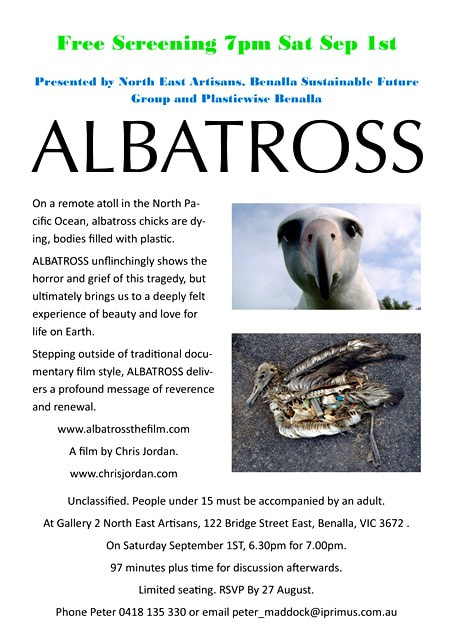
The Group has taken a break for the remainder of the year with two very dedicated ladies continuing to sew at home. There may be potential in the near future for this Group to assist some keen young people to promote the reduction of plastic usage within Benalla. Wendi Baker, Plastic Wise Benalla Convenor, May 23 2019 The film Albatross by Chris Jordan was screened at North East Artisans on Saturday 1st August. A joint initiative of BSFG, Plastic Wise Benalla and NEA, the film was introduced by Wendy Baker from Plastic Wise Benalla and BSFG's Peter Maddock, with the screening followed by discussion and tea/coffee. . Peter's inspiration for screening the film in Benalla is evident from the preamble he wrote prior to its screening... "I spoke to Tim Bowtell at NEA a few years ago about screening a film at NEA. At the time I was influenced by seeing a recording of Art Climate Ethics: What Role for the Arts? at the Melbourne Sustainable Living Festival 2014. This presentation featured a number of artists talking about their art and climate change and was presented by Guy Abrahams of CLIMARTE: Arts for a Safe Climate. One of the featured artists was Chris Jordan director of Albatross who spoke about his making of the film on Midway Island, https://www.albatrossthefilm.com/ Over recent months I have looked up some of Chris Jordan’s work and have come to see how Chris wants to take us beyond the numbers used to describe our impact on the environment. By showing us the consequences of the cultural choices we make he wants us to feel these impacts, because large numbers such as tons of carbon emissions, the number of species threatened with extinction, etc. doesn’t mean much to us. Chris Jordan’s website presents some amazing Photographic Arts, in particular some animations titled Running the Numbers: An American Self-Portrait and Running the Numbers II: Portraits of global mass culture, visualising the numbers resulting from our personal consumption. In his TedX talk 'Midway Journey' Chris describes his artistic work as “visualising and facing the invisible truths of our time”. Earlier this year I came across a video of Chris talking about the making of Albatross on Midway Island. In particular I was taken by his comment that the tragedy unfolding on Midway from our plastic pollution in the Pacific is a bit like global warming, it is largely invisible to us. Chris’ message is that he wants us to feel the tragedy of our times. A wakeup call for us to make new choices. This year Albatross was screened at the Transition Film Festival in Melbourne and has been offered by Chris Jordan as a free public screening to spread the word about the tragedy of plastic pollution in the middle of the Pacific Ocean. So thank you to Tim and North East Artisans for providing us with the opportunity to screen Albatross at NEA.
A reminder also that Tim Bowtell has in his own way been visualising some of the tragedies of our times. His mural at Benalla Wall Art this year was “Cornography”, a critique of our modern corporate food chain. And most recently Tim’s entry in the inaugural Swanpool SCRAP Art Prize, the “Treadmill of Perpetual Happiness” is now situated at the entry to North East Artisans." (Peter Maddock) People who attended the screening of Albatross at NEA were clearly very moved by it. NEA member Pamella Francis wrote the following comment on NEA's Facebook page - "I attended the free ALBATROSS movie last night, Saturday 1st Sept at NEA.... I was totally aghast at what we, as humans are doing to our beautiful planet and the animals who innocently go about their lives unaware of the dangers that they ingest and pass on to their offspring. The parent bird don't know that they are slowly killing them. As humans we at least have choice and can be aware of the dangers of what we choose to eat and the lifestyles we live in. Whilst there is a minority of people who are trying to do the 'right' thing with plastic, recycling etc etc... the BIG companies need to get on board if real changes can be made! I don't usually say much on FB just "like" what other people post but I can't not say something about this movie on the Albatross. If everyone took the time to watch this move, they would be moved to change". In collaboration with North East Artisans, Benalla Sustainable Future Group and Plastic Wise Benalla presents a free screening of the film Albatross on Saturday September 1ST at 7:00PM.
On a remote atoll in the North Pacific Ocean, albatross chicks are dying, bodies filled with plastic. ALBATROSS unflinchingly shows the horror and grief of this tragedy, but ultimately brings us to a deeply felt experience of beauty and love for life on Earth. Stepping outside of traditional documentary film style, ALBATROSS delivers a profound message of reverence and renewal. Chris Jordan is a multi-media artist based in Seattle. His work explores contemporary mass culture from a variety of photographic and conceptual perspectives, connecting the viewer viscerally to the enormity and power of humanity’s collective unconscious. Jordan’s work edgewalks the lines between beauty and horror, abstraction and representation, and the visible and the invisible, challenging us to look both in-ward and outward at the complex landscapes of our collective choices (www.chrisjordan.com). Jordan’s work reaches an increasingly broad international audience through his exhibitions, books, web-site, interviews on radio and television, and speaking engagements and school visits all over the world. He is currently involved in an international tour of his first feature film ALBATROSS, bringing to world the awareness and message of plastic pollution’s devastation effect on the albatrosses of Midway island (www.albatrossthefilm.com). This film is exempt from classification and is restricted to people over 15 years. People under 15 must be accompanied by an adult. Running for 97 minutes there will be time for discussion afterwards. Free screening at NEA, 122 Bridge Street East, Benalla, VIC 3672, Sat Sep 1ST, 6.30pm for 7.00pm Start. Limited seating. Additional screenings may be possible. RSVP By 27 August; Phone Peter 0418 135 330 or email [email protected].
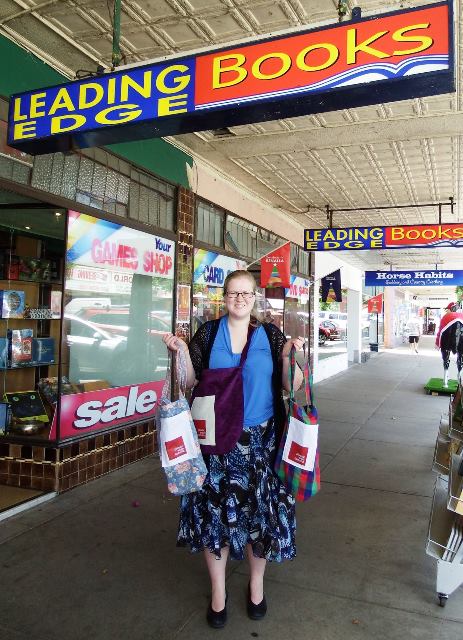
This action group of BSFG has been fairly active in the last few months making upcycled fabric bags in an effort to encourage the use of reusable bags and to create a thought process about our consumption of plastics. An enthusiastic and passionate team have been hard at work sourcing unwanted clean fabric; cutting fabric to size; and then sewing the bags. Working bees have been held fortnightly at the Drill Hall. The next session will be held on 19th December from 12.30pm until 3.30pm All are welcome. No sewing skills are necessary as we also require cutters, ironers, and fabric matchers. We had a very successful sell day at the BSFG stall at the Day in the Gardens Market and we continue to sell the bags for $5 each. Any monies raised will go back in to the project to support our plastic reduction goal. I would like to thank the local businesses that are stocking the bags. These businesses are One Wild Apple Cafe, Leading Edge Books, Blooms on Bridge, Samaria Farm and the BSFG Bulk Food Co-op. If you know of any other business that would be interested in selling them please let me know. I would also like to thank the team of hard working individuals, whether you are a fabric finder, a cutter, ironer, salesperson or seamstress. We have a great team who encourages each other; has a laugh and good chat when we get together; and is also very productive. We have a great team who encourages each other; has a laugh and good chat when we get together; and is also very productive. We are also very passionate about reducing the amount of plastic used in our community. Thank you all.
I know that several of the bags have been sent internationally and are being used for Christmas presents in lieu of wrapping paper. Please support the businesses who are stocking them. If you would like to help in any way please email me: [email protected] Wendy Baker Plastic Wise Benalla This item was first published in the December 2017 BSFG Newsletter. Tuesdays, September 26, October 10, October 24, November 7, November 21, December 5, December 19, 12.30 to 3.30 pm: Plastic Wise Benalla, under the auspice of the Benalla Sustainable Future Group, is working towards reducing the impact of single use plastic on our community. Upcycled bags are sewn with love by community volunteers, Working bees are held Tuesdays, 12.30 pm to 3.30 pm, at the Benalla Drill Hall. Anyone is welcome to come along and help create bags for our community, all help is appreciated. No sewing necessary - the commmunity group also needs help with cutting, sourcing material, ironing and pinning - there's plenty to do for all skill levels! Other options for support include sew-at-home kits; donations (sturdy material suitable for bags such as calico, curtains and tablecloths, and cotton for sewing up the bags). Purchases will be available as well shortly for $5, with all proceeds going back into the community. Source: Benalla Ensign, Wednesday September 20, 2017 p 12
The Benalla Plastic Wise community sewing events have been growing each fortnight as the community becomes more aware of the damage that single use plastic has on our environment. Every fortnight a team of committed volunteers meet at the Drill Hall to lend their time and skill to creating reusable bags from upcycled materials. Take-home kits have also been a hit, with those who cannot make the working bees picking up a sewing kit and helping out from home. Without our wonderful community this venture wouldn't be possible. With even the big chain supermarkets getting on board it won't be long until everyone will sporting our beautiful bags! We hope to see you soon! If you would like to grab a sew-at-home kit, or can donate some material or cotton, please get in touch so we can continue to provide for our community, and for our environment. Wendy Baker We are making some progress with our Plastic Sub-committee. We recently had our first 'bag making session' where we are upcycling scrap/waste material into very trendy bags. We are not calling them boomerang bags but obviously a similar type of thing. We intend to sell them at various outlets and to our friends for $2 to $3. Haven't decided on the price yet. We are investigating how to promote this on social media. Ideas include linking "Plastic Wise Benalla' on the BSFG website and setting up our own facebook page. BSFG will be the overarching body for our Group, Plastic Wise Benalla. We have our own logo which is based around that used in by the Indigo Shire Groups. Jason, Fabio Industries, has screen printed our first batch of pockets for free. And the Council have provided us with a room at the Drill Hall for free for bag making sessions each fortnight for the next 2 months. It is great that we are creating some community action about this issue and some wonderful helpers have been recruited. We have started off small just to get ourselves organised. We have several people who are very willing to sew at home which is great. Any donations of heavy duty fabric, curtains/tablecloths, and not so heavy duty (for a contrast), and calico will be gratefully accepted. Wendy Bacon Plastic Free July is an international initiative developed by a Perth council to raise awareness of the amount of plastic in our lives. The challenge is to refuse single use plastic during July.
Some of you may think it is too difficult to stop using plastic. It is. Plastic is ubiquitous and it is made to last a very long time. It is packaged around our food. Some would even say it has started to become a part of our food. It is in our make-up and personal hygiene products. It is in our clothing. However, if we put in a little thought and effort we all can reduce our usage of plastic. I have been concerned about the impact of plastics on the environment for years. This concern was heightened on a recent trip to Sri Lanka where I was totally disheartened by the rubbish on the beaches, in the ocean and on the streets. Waste reduction is a global responsibility. Some ideas to aid in this challenge would be to:
Continue the challenge if travelling:
Think- Reduce, Reuse, Refuse, Rethink, Repair. If we are all a little wiser with our purchases and consumption habits, a cleaner and healthier environment will follow. For more ideas and to accept the challenge go to www.plasticfreejuly.org Choose to Refuse. Source: Baker, W 'Ecoportal' http://ecoportal.net.au/plastic-free-july/ 21 July 2017 Maybe you are not ready to give up the plastic altogether but there are some easy ways to make a big difference in reducing the amount of plastic waste that is a huge burden to our environment. Recycling goes some of the way to easing the issue; however it is a much better option to avoid the use of plastic as much as possible.
Bring your own shopping bag I am thinking hessian is best. Or why not make your own out of left over fabric? In addition to bigger carryall bags, you can take your own reusable produce bags or don’t use produce bags at all. Ditch bottled water Such an easy way to reduce waste. Keep a refillable bottle handy and take it wherever you go. Bottled water is incredibly expensive compared to the tap. Say ‘no’ to bottled water. BYO Coffee Cup Coffee Cups are usually lined with a polyethylene making it difficult to be recycled. Take your own refillable cup....you may even get your coffee at a reduced price!! Choose cardboard over plastic bottles and bags Try pasta in a box instead of a bag, detergent in a box instead of a bottle. Even better, see if the cardboard is from a sustainable source. Say ‘no’ to straws They are just not necessary. Paper or stainless straws are an option. Get plastic out of the makeup drawer and bathroom Research microbeads. Aim for none in your products. Skip the disposable razor Re-think your food storage Try to use glass instead of plastic for fridge/pantry storage. Take your own containers for the left over restaurant meal. Use reusable sandwich wraps e.g.‘Keep Leaf’ eco-friendly bags. Use cloth nappies over disposable nappies Shop in Bulk Consider joining the BSFG Bulk Food Co-op. Keep your eye out for places with refill stations or bulk purchases. Think about fashion choices Do you really need another item of clothing? Consider clothes swapping with your friends and family. Check out the Op Shop. Travelling? Try to follow the practices you have at home. Carry a lightweight rolled-up reusable carry bag. Purify the tap water – choose to avoid the bottled water. My daughter recently travelled Sri Lanka, India and Nepal for 3 months and used a ‘Steripen’ handheld water purifier....was fantastic, easy to use, saved heaps of dollars, and heaps of plastic bottle waste. CHOOSE TO REFUSE Check out the ABC’s “War on Waste”: http://www.abc.net.au/ourfocus/waronwaste/ And the website for “Plastic Free July”: http://www.plasticfreejuly.org/ Also recommended reading: http://treadingmyownpath.com/2017/01/12/onlinezero-waste-plastic-free-stores/ Wendy Baker BSFG Plastic Bag Action Group Source BSFG's May Newsletter, 2017 |
|
|
|